Skip to content

How it works

AMM does not contain a new search method. It decides which classical method gets the evaluation budget, and when, by reading the function with cheap probes. It is given the dimension D, the budget B, the box and the function values at the points it evaluates, and nothing else: no function name, no optimum value. The thresholds depend on D and B only. Every probe evaluation counts against B, and every evaluated point lies in the box. One configuration serves all functions.

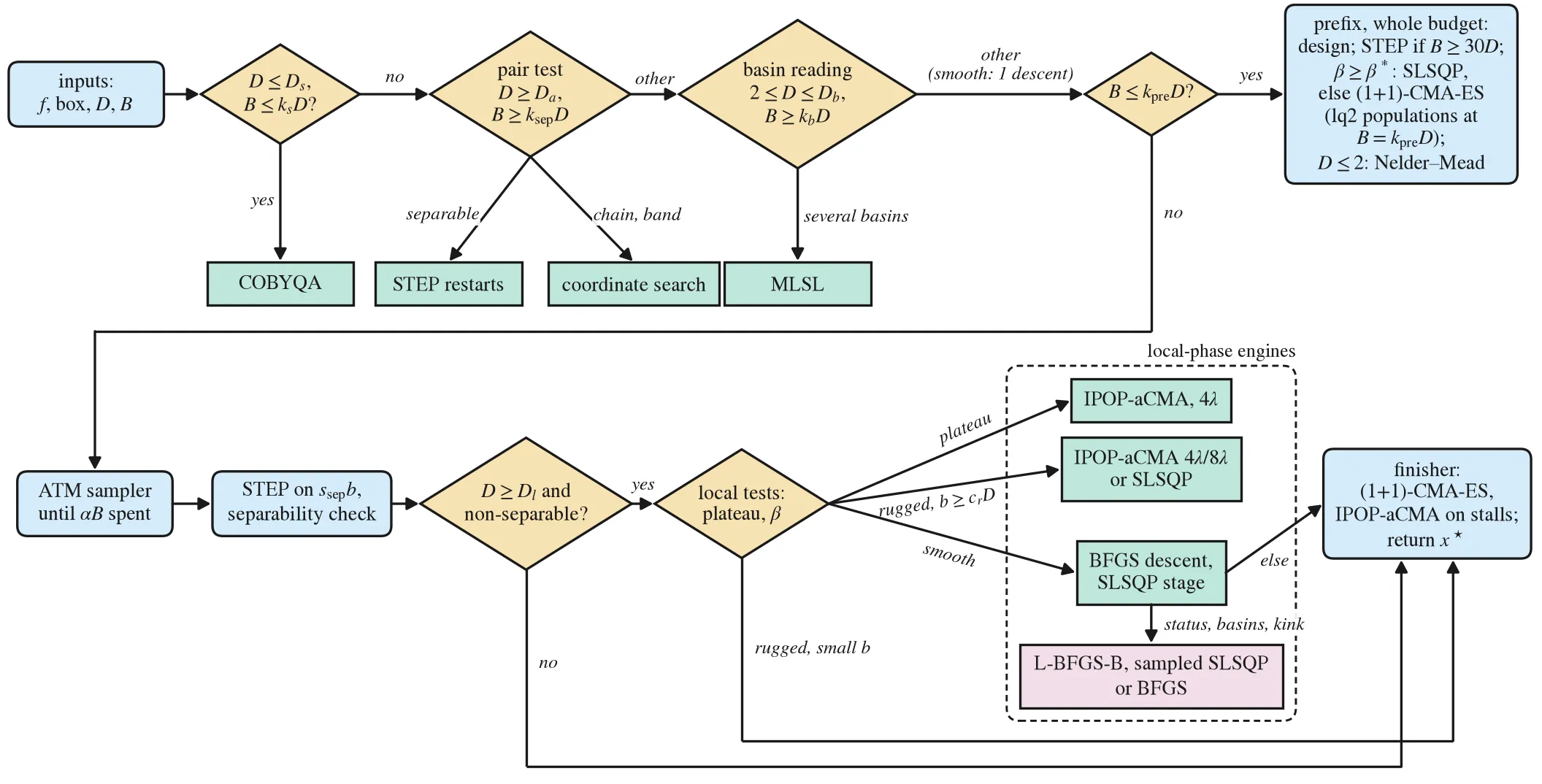
Flowchart of AMM. Inputs f, box, D and B enter a chain of gates. If D and B are small, COBYQA gets the whole budget. Otherwise a pair test can send a separable function to STEP restarts or a chained function to coordinate search, and a basin reading can send a function with several basins to MLSL. If B is at most about 100 times D, a prefix uses the whole budget. Otherwise the ATM sampler runs, then STEP with a separability check, then, for non-separable functions of dimension 5 or more, local tests (plateau, curvature) choose between IPOP-aCMA, a BFGS and SLSQP stage, or the finisher. A finisher closes every path.
diagram of the frozen designRouting of AMM as in the paper draft (preset c43). Rounded boxes are phases, diamonds are probes or gates, square boxes are engines; the dashed box groups the engines that spend the rest of the budget. A probe that does not trigger a route costs its evaluations and the run continues to the right. This is a diagram of code, not a result.
Reproduce this figure
command
rendered by the paper figure pipeline from latex/figs/src/overview_diagram.tex
seed
pending: filled from the run manifest
instance ids
pending: filled from the run manifest
budgets
pending: filled from the run manifest
commit
draft v3: preset c43, hash 781edd1e0767c7e2. Frozen preset: c46, hash 2153948ebed51150
competitors
pending: filled from the run manifest
hardware
not applicable
cost
not applicable

Five stages, in the order a run meets them. D is the dimension, B the budget and b the evaluations left. Symbols and thresholds are those of the paper draft’s Table 2.

  1. Whole-budget gates. Three gates can hand the whole budget to one engine. At D up to 3 and B up to 10D, restarted COBYQA runs, because no probe would pay for itself. From D = 5 and B of at least 100D, a pair test reads whether the function is additive over pairs of coordinates: a separable reading goes to STEP restarts, and a reading where only adjacent coordinates interact (confirmed by a band check, from 300D) goes to a coordinate search along decoupled directions. At D = 2 to 3 from 100D, a basin reading sends a landscape with several smooth basins to MLSL. A gate that does not fire costs only its evaluations.
  2. The prefix (B up to 100D). The prefix spends the whole budget: a uniform design, STEP from 30D, then a curvature probe that sends a smooth reading to restarted SLSQP and a rugged one to a (1+1)-CMA-ES (or, at 100D, to populations ranked by a quadratic surrogate). Below 31D and 200 evaluations the probe is skipped: one SLSQP descent, then the (1+1)-CMA-ES. At D of 2 or less, Nelder–Mead restarts replace the evolution strategy.
  3. The ATM stage (B above 100D). The ATM sampler takes a fifth of the budget (at most 60D from D = 10), then STEP takes half of what is left, with a separability check.
  4. Local probes (D of 5 or more, non-separable). A plateau probe and the curvature probe classify the incumbent. A plateau goes to IPOP-aCMA-ES with four times the default population. A rugged reading with much budget left goes to the same schedule, unless a fractal probe diverts it to restarted SLSQP. A smooth reading goes to an SLSQP stage, which its exit status, a hill-valley test and a kink reading can end early.
  5. The finisher. A restarted (1+1)-CMA-ES that hands stalls to IPOP-aCMA-ES populations.

Each probe reads points the run evaluated anyway or a few extra ones, and its cost is charged to B. When a probe does not fire, the run stays on its default path. Function names in the last column are in src/amm_optimizer/ of the public repository (the development code lived in src/atm/).

Probe What it reads Cost (evaluations) Fires: sends the budget to Default when it does not fire Code
Pair test Additivity residual of f over adjacent and random distant coordinate pairs. A residual of at least 1e-6 on a distant pair reads non-separable; on adjacent pairs only, a chain 3D+1 Separable: STEP restarts. Chain, after a band check (6D evaluations): coordinate search Non-separable: the run continues chain_phase.pair_test, band_consistency
Basin reading Rank-quadratic R² on a Sobol design (at most 0.5 reads several basins), and the change of second differences between two scales (at most 0.1 reads smooth) Design, then 4D Several basins: MLSL. One smooth basin up to 300D: one SLSQP descent first Continue from the design’s best point basin_phase.rank_quadratic_r2, local_reading, multi_basin_route
Curvature β Slope of the log of the mirrored loss against log step at three scales (a quadratic gives 2). At least 1.45 reads smooth 24 (12 below 30D) Smooth: restarted SLSQP (prefix) or the smooth route (1+1)-CMA-ES or populations qn_phase.curvature_beta
Plateau Four mirrored probes at 3e-4 of the box width; at least half repeat f(x) exactly 4 IPOP-aCMA-ES with four times the default population Curvature probe qn_phase.plateau_check
STEP separability check A stored point re-evaluated after the incumbent moved along another axis; from 1000D a two-axis check once STEP stalls Re-evaluations Separable: straight to the finisher Local probes step_phase.run_step_phase
Fractal (D of 20 or more) Mirrored second differences at four scales from 1e-7 to 1e-4 of the box width 32 Fractal: restarted SLSQP IPOP schedule qn_phase.micro_slopes
Kink Mirrored second difference at 1e-7 of the box width, at least 5e7 6 Scaled finite-difference BFGS Finisher qn_phase.kink_check
Hill-valley Whether a point between two converged descent ends is worse than both Up to 9 Separate basins: sampled SLSQP restarts Finisher qn_phase.multi_basin
Exit status and stall monitor SLSQP’s own exits and iterations (a majority of failed exits; progress of the first descent) 0 Failed majority: L-BFGS-B Finisher qn_phase.failure_majority

The curvature, pair, local-basin and fractal readings are invariant to f → af + c with a > 0, and the plateau, rank and hill-valley tests to any increasing transformation of f. The kink threshold is absolute and is tied to the scale of bbob’s function values. Sources: paper draft v3, section 3.2 and appendix B.1; the constants were checked against the frozen code (for example BETA_THRESHOLD, TIE_SCALE, KINK_D2, SEP_TOL).

All engines return when they converge, spend their share or stall, and every result is offered to an incumbent that never gets worse. Restarted engines restart from uniform points until their share is spent.

Engine What it is Used for
COBYQA SciPy’s trust-region method on quadratic models, restarted; initial trust radius 0.25 of the box width Whole-budget gate at small D and B
SLSQP SciPy’s, box bounds, forward-difference step 1e-9 Prefix, basin descents, MLSL, the smooth local route
L-BFGS-B SciPy’s, ten correction pairs Takes the rest when most SLSQP descents fail
Scaled finite-difference BFGS Nonsmooth BFGS in the style of Lewis and Overton One try on smooth readings at small budgets; after a kink
Nelder–Mead restarts Simplex method D of 2 or less
STEP Round-robin coordinate search in the style of BSrr Separable route; a stage after the ATM sampler
Coordinate search Global line searches along decoupled directions Chain reading
MLSL SLSQP descents from Sobol points that no better point nearby beats Several-basin reading at D = 2 to 3
(1+1)-Cholesky-CMA-ES With active update and quadratic-model steps Prefix and finisher
IPOP-aCMA-ES (μ/μw,λ)-CMA-ES with active update and box clipping, restarted with growing populations Plateau and rugged routes; stalls of the finisher
ATM sampler Population-based random search: four sub-samplers, a resource allocator, success-rate control of step widths The stage after the prefix range

References for the engines are on the paper page; the draft still marks several identifiers as to be found.

The map shows, for each dimension and budget multiplier, which stage runs first and the stage list a run follows when no probe routes the whole budget. Hover, focus or tap a cell. The map was produced by a dry run of the configuration’s own control flow with the probe outcomes forced, so it shows what is possible in a cell and what the default path is, not which route a given function takes.

Routing map of preset c43. Rows: dimension D. Columns: budget as a multiple of D. Each cell shows what runs first and, by letter, pattern and colour, the default path.
D \ B10×D30×D100×D300×D1000×D3000×D
D = 2COBYQAprefixbasinbasinbasinbasin
D = 3COBYQAprefixbasinbasinbasinbasin
D = 5prefixprefixpairpairpairpair
D = 10prefixprefixpairpairpairpair
D = 20prefixprefixpairpairpairpair
D = 40prefixprefixpairpairpairpair
  • COBYQA spends the whole budget
  • prefix: one SLSQP descent, then (1+1)-CMA-ES
  • prefix with the curvature probe (SLSQP or CMA-ES)
  • prefix with Nelder–Mead (D = 2)
  • ATM stage, STEP, then local tests (D ≥ 5)
  • ATM stage, STEP, then the finisher (D = 2–3)

The word in a cell is the first stage that spends evaluations: COBYQA, the prefix, the pair test or the basin reading. The colours mark paths, not methods.

Text version: all 36 cells
Default stage list and possible whole-budget routes of every cell, in the order a run meets them.
DBudgetDefault stages (no route fires)Whole-budget routes possible here
210×D = 20
  1. restarted COBYQA, whole budget
  • STEP restarts: not available
  • coordinate search: not available
  • MLSL: not available
230×D = 60
  1. prefix, whole budget (60 evaluations): uniform design; STEP on half of the evaluations left; one SLSQP descent, then Nelder–Mead restarts
  • STEP restarts: not available
  • coordinate search: not available
  • MLSL: not available
2100×D = 200
  1. basin reading: Sobol design and a local reading; several smooth basins go to MLSL, one smooth basin gets one SLSQP descent
  2. SLSQP descent, 1 (default path: one smooth basin)
  3. prefix, whole budget (200 evaluations): uniform design; STEP on half of the evaluations left; Nelder–Mead restarts
  • STEP restarts: not available
  • coordinate search: not available
  • MLSL: possible, if the basin reading finds several basins
2300×D = 600
  1. basin reading: Sobol design and a local reading; several smooth basins go to MLSL, one smooth basin gets one SLSQP descent
  2. SLSQP descent, 1 (default path: one smooth basin)
  3. ATM sampler, 120 evaluations (a fifth of the budget; at most 60D from D = 10)
  4. STEP, 240 evaluations, then a one-axis separability check
  5. finisher: restarted (1+1)-CMA-ES, IPOP-aCMA-ES on stalls
  • STEP restarts: not available
  • coordinate search: not available
  • MLSL: possible, if the basin reading finds several basins
21000×D = 2000
  1. basin reading: Sobol design and a local reading; several smooth basins go to MLSL, no descent at this budget
  2. ATM sampler, 400 evaluations (a fifth of the budget; at most 60D from D = 10)
  3. STEP, 800 evaluations, then a two-axis separability check once STEP stalls (from 1000D)
  4. finisher: restarted (1+1)-CMA-ES, IPOP-aCMA-ES on stalls
  • STEP restarts: not available
  • coordinate search: not available
  • MLSL: possible, if the basin reading finds several basins
23000×D = 6000
  1. basin reading: Sobol design and a local reading; several smooth basins go to MLSL, no descent at this budget
  2. ATM sampler, 1200 evaluations (a fifth of the budget; at most 60D from D = 10)
  3. STEP, 2400 evaluations, then a two-axis separability check once STEP stalls (from 1000D)
  4. finisher: restarted (1+1)-CMA-ES, IPOP-aCMA-ES on stalls
  • STEP restarts: not available
  • coordinate search: not available
  • MLSL: possible, if the basin reading finds several basins
310×D = 30
  1. restarted COBYQA, whole budget
  • STEP restarts: not available
  • coordinate search: not available
  • MLSL: not available
330×D = 90
  1. prefix, whole budget (90 evaluations): uniform design; STEP on half of the evaluations left; one SLSQP descent from the design’s best point, then (1+1)-CMA-ES; no probe
  • STEP restarts: not available
  • coordinate search: not available
  • MLSL: not available
3100×D = 300
  1. basin reading: Sobol design and a local reading; several smooth basins go to MLSL, one smooth basin gets one SLSQP descent
  2. SLSQP descent, 1 (default path: one smooth basin)
  3. prefix, whole budget (300 evaluations): uniform design; STEP on half of the evaluations left; curvature probe β (24 evaluations): smooth gives restarted SLSQP, rugged gives lq2 populations
  • STEP restarts: not available
  • coordinate search: not available
  • MLSL: possible, if the basin reading finds several basins
3300×D = 900
  1. basin reading: Sobol design and a local reading; several smooth basins go to MLSL, one smooth basin gets one SLSQP descent
  2. SLSQP descent, 1 (default path: one smooth basin)
  3. ATM sampler, 180 evaluations (a fifth of the budget; at most 60D from D = 10)
  4. STEP, 360 evaluations, then a one-axis separability check
  5. finisher: restarted (1+1)-CMA-ES, IPOP-aCMA-ES on stalls
  • STEP restarts: not available
  • coordinate search: not available
  • MLSL: possible, if the basin reading finds several basins
31000×D = 3000
  1. basin reading: Sobol design and a local reading; several smooth basins go to MLSL, no descent at this budget
  2. ATM sampler, 600 evaluations (a fifth of the budget; at most 60D from D = 10)
  3. STEP, 1200 evaluations, then a two-axis separability check once STEP stalls (from 1000D)
  4. finisher: restarted (1+1)-CMA-ES, IPOP-aCMA-ES on stalls
  • STEP restarts: not available
  • coordinate search: not available
  • MLSL: possible, if the basin reading finds several basins
33000×D = 9000
  1. basin reading: Sobol design and a local reading; several smooth basins go to MLSL, no descent at this budget
  2. ATM sampler, 1800 evaluations (a fifth of the budget; at most 60D from D = 10)
  3. STEP, 3600 evaluations, then a two-axis separability check once STEP stalls (from 1000D)
  4. finisher: restarted (1+1)-CMA-ES, IPOP-aCMA-ES on stalls
  • STEP restarts: not available
  • coordinate search: not available
  • MLSL: possible, if the basin reading finds several basins
510×D = 50
  1. prefix, whole budget (50 evaluations): uniform design; one SLSQP descent from the design’s best point, then (1+1)-CMA-ES; no probe
  • STEP restarts: not available
  • coordinate search: not available
  • MLSL: not available
530×D = 150
  1. prefix, whole budget (150 evaluations): uniform design; STEP on half of the evaluations left; one SLSQP descent from the design’s best point, then (1+1)-CMA-ES; no probe
  • STEP restarts: not available
  • coordinate search: not available
  • MLSL: not available
5100×D = 500
  1. pair test, 16 evaluations (3D+1); default reading: not separable
  2. prefix, whole budget (500 evaluations): uniform design; STEP on half of the evaluations left; curvature probe β (24 evaluations): smooth gives restarted SLSQP, rugged gives lq2 populations
  • STEP restarts: possible, if the pair test reads separable
  • coordinate search: not available
  • MLSL: not available
5300×D = 1500
  1. pair test, 16 evaluations (3D+1); default reading: not separable
  2. ATM sampler, 300 evaluations (a fifth of the budget; at most 60D from D = 10)
  3. STEP, 600 evaluations, then a one-axis separability check
  4. local tests (non-separable reading only): plateau probe, then curvature probe β; plateau, rugged and smooth readings each pick an engine

If STEP’s separability check reads separable, the local tests are skipped and the finisher follows.

  • STEP restarts: possible, if the pair test reads separable
  • coordinate search: possible, if the pair test reads a chain and the band check passes
  • MLSL: not available
51000×D = 5000
  1. pair test, 16 evaluations (3D+1); default reading: not separable
  2. ATM sampler, 1000 evaluations (a fifth of the budget; at most 60D from D = 10)
  3. STEP, 2000 evaluations, then a two-axis separability check once STEP stalls (from 1000D)
  4. local tests (non-separable reading only): plateau probe, then curvature probe β; plateau, rugged and smooth readings each pick an engine

If STEP’s separability check reads separable, the local tests are skipped and the finisher follows.

  • STEP restarts: possible, if the pair test reads separable
  • coordinate search: possible, if the pair test reads a chain and the band check passes
  • MLSL: not available
53000×D = 15000
  1. pair test, 16 evaluations (3D+1); default reading: not separable
  2. ATM sampler, 3000 evaluations (a fifth of the budget; at most 60D from D = 10)
  3. STEP, 6000 evaluations, then a two-axis separability check once STEP stalls (from 1000D)
  4. local tests (non-separable reading only): plateau probe, then curvature probe β; plateau, rugged and smooth readings each pick an engine

If STEP’s separability check reads separable, the local tests are skipped and the finisher follows.

  • STEP restarts: possible, if the pair test reads separable
  • coordinate search: possible, if the pair test reads a chain and the band check passes
  • MLSL: not available
1010×D = 100
  1. prefix, whole budget (100 evaluations): uniform design; one SLSQP descent from the design’s best point, then (1+1)-CMA-ES; no probe
  • STEP restarts: not available
  • coordinate search: not available
  • MLSL: not available
1030×D = 300
  1. prefix, whole budget (300 evaluations): uniform design; STEP on half of the evaluations left; curvature probe β (24 evaluations): smooth gives restarted SLSQP, rugged gives (1+1)-CMA-ES
  • STEP restarts: not available
  • coordinate search: not available
  • MLSL: not available
10100×D = 1000
  1. pair test, 31 evaluations (3D+1); default reading: not separable
  2. prefix, whole budget (1000 evaluations): uniform design; STEP on half of the evaluations left; curvature probe β (24 evaluations): smooth gives restarted SLSQP, rugged gives lq2 populations
  • STEP restarts: possible, if the pair test reads separable
  • coordinate search: not available
  • MLSL: not available
10300×D = 3000
  1. pair test, 31 evaluations (3D+1); default reading: not separable
  2. ATM sampler, 600 evaluations (a fifth of the budget; at most 60D from D = 10)
  3. STEP, 1200 evaluations, then a one-axis separability check
  4. local tests (non-separable reading only): plateau probe, then curvature probe β; plateau, rugged and smooth readings each pick an engine

If STEP’s separability check reads separable, the local tests are skipped and the finisher follows.

  • STEP restarts: possible, if the pair test reads separable
  • coordinate search: possible, if the pair test reads a chain and the band check passes
  • MLSL: not available
101000×D = 10000
  1. pair test, 31 evaluations (3D+1); default reading: not separable
  2. ATM sampler, 600 evaluations (a fifth of the budget; at most 60D from D = 10)
  3. STEP, 4700 evaluations, then a two-axis separability check once STEP stalls (from 1000D)
  4. local tests (non-separable reading only): plateau probe, then curvature probe β; plateau, rugged and smooth readings each pick an engine

If STEP’s separability check reads separable, the local tests are skipped and the finisher follows.

  • STEP restarts: possible, if the pair test reads separable
  • coordinate search: possible, if the pair test reads a chain and the band check passes
  • MLSL: not available
103000×D = 30000
  1. pair test, 31 evaluations (3D+1); default reading: not separable
  2. ATM sampler, 600 evaluations (a fifth of the budget; at most 60D from D = 10)
  3. STEP, 14700 evaluations, then a two-axis separability check once STEP stalls (from 1000D)
  4. local tests (non-separable reading only): plateau probe, then curvature probe β; plateau, rugged and smooth readings each pick an engine

If STEP’s separability check reads separable, the local tests are skipped and the finisher follows.

  • STEP restarts: possible, if the pair test reads separable
  • coordinate search: possible, if the pair test reads a chain and the band check passes
  • MLSL: not available
2010×D = 200
  1. prefix, whole budget (200 evaluations): uniform design; curvature probe β with 2 directions (12 evaluations): smooth gives restarted SLSQP, rugged gives (1+1)-CMA-ES
  • STEP restarts: not available
  • coordinate search: not available
  • MLSL: not available
2030×D = 600
  1. prefix, whole budget (600 evaluations): uniform design; STEP on half of the evaluations left; curvature probe β (24 evaluations): smooth gives restarted SLSQP, rugged gives (1+1)-CMA-ES
  • STEP restarts: not available
  • coordinate search: not available
  • MLSL: not available
20100×D = 2000
  1. pair test, 61 evaluations (3D+1); default reading: not separable
  2. prefix, whole budget (2000 evaluations): uniform design; STEP on half of the evaluations left; curvature probe β (24 evaluations): smooth gives restarted SLSQP, rugged gives lq2 populations
  • STEP restarts: possible, if the pair test reads separable
  • coordinate search: not available
  • MLSL: not available
20300×D = 6000
  1. pair test, 61 evaluations (3D+1); default reading: not separable
  2. ATM sampler, 1200 evaluations (a fifth of the budget; at most 60D from D = 10)
  3. STEP, 2400 evaluations, then a one-axis separability check
  4. local tests (non-separable reading only): plateau probe, then curvature probe β; plateau, rugged and smooth readings each pick an engine

If STEP’s separability check reads separable, the local tests are skipped and the finisher follows.

  • STEP restarts: possible, if the pair test reads separable
  • coordinate search: possible, if the pair test reads a chain and the band check passes
  • MLSL: not available
201000×D = 20000
  1. pair test, 61 evaluations (3D+1); default reading: not separable
  2. ATM sampler, 1200 evaluations (a fifth of the budget; at most 60D from D = 10)
  3. STEP, 9400 evaluations, then a two-axis separability check once STEP stalls (from 1000D)
  4. local tests (non-separable reading only): plateau probe, then curvature probe β; plateau, rugged and smooth readings each pick an engine

If STEP’s separability check reads separable, the local tests are skipped and the finisher follows.

  • STEP restarts: possible, if the pair test reads separable
  • coordinate search: possible, if the pair test reads a chain and the band check passes
  • MLSL: not available
203000×D = 60000
  1. pair test, 61 evaluations (3D+1); default reading: not separable
  2. ATM sampler, 1200 evaluations (a fifth of the budget; at most 60D from D = 10)
  3. STEP, 29400 evaluations, then a two-axis separability check once STEP stalls (from 1000D)
  4. local tests (non-separable reading only): plateau probe, then curvature probe β; plateau, rugged and smooth readings each pick an engine

If STEP’s separability check reads separable, the local tests are skipped and the finisher follows.

  • STEP restarts: possible, if the pair test reads separable
  • coordinate search: possible, if the pair test reads a chain and the band check passes
  • MLSL: not available
4010×D = 400
  1. prefix, whole budget (400 evaluations): uniform design; curvature probe β with 2 directions (12 evaluations): smooth gives restarted SLSQP, rugged gives (1+1)-CMA-ES
  • STEP restarts: not available
  • coordinate search: not available
  • MLSL: not available
4030×D = 1200
  1. prefix, whole budget (1200 evaluations): uniform design; STEP on half of the evaluations left; curvature probe β (24 evaluations): smooth gives restarted SLSQP, rugged gives (1+1)-CMA-ES
  • STEP restarts: not available
  • coordinate search: not available
  • MLSL: not available
40100×D = 4000
  1. pair test, 121 evaluations (3D+1); default reading: not separable
  2. prefix, whole budget (4000 evaluations): uniform design; STEP on half of the evaluations left; curvature probe β (24 evaluations): smooth gives restarted SLSQP, rugged gives lq2 populations
  • STEP restarts: possible, if the pair test reads separable
  • coordinate search: not available
  • MLSL: not available
40300×D = 12000
  1. pair test, 121 evaluations (3D+1); default reading: not separable
  2. ATM sampler, 2400 evaluations (a fifth of the budget; at most 60D from D = 10)
  3. STEP, 4800 evaluations, then a one-axis separability check
  4. local tests (non-separable reading only): plateau probe, then curvature probe β; plateau, rugged and smooth readings each pick an engine

If STEP’s separability check reads separable, the local tests are skipped and the finisher follows.

  • STEP restarts: possible, if the pair test reads separable
  • coordinate search: possible, if the pair test reads a chain and the band check passes
  • MLSL: not available
401000×D = 40000
  1. pair test, 121 evaluations (3D+1); default reading: not separable
  2. ATM sampler, 2400 evaluations (a fifth of the budget; at most 60D from D = 10)
  3. STEP, 18800 evaluations, then a two-axis separability check once STEP stalls (from 1000D)
  4. local tests (non-separable reading only): plateau probe, then curvature probe β; plateau, rugged and smooth readings each pick an engine

If STEP’s separability check reads separable, the local tests are skipped and the finisher follows.

  • STEP restarts: possible, if the pair test reads separable
  • coordinate search: possible, if the pair test reads a chain and the band check passes
  • MLSL: not available
403000×D = 120000
  1. pair test, 121 evaluations (3D+1); default reading: not separable
  2. ATM sampler, 2400 evaluations (a fifth of the budget; at most 60D from D = 10)
  3. STEP, 58800 evaluations, then a two-axis separability check once STEP stalls (from 1000D)
  4. local tests (non-separable reading only): plateau probe, then curvature probe β; plateau, rugged and smooth readings each pick an engine

If STEP’s separability check reads separable, the local tests are skipped and the finisher follows.

  • STEP restarts: possible, if the pair test reads separable
  • coordinate search: possible, if the pair test reads a chain and the band check passes
  • MLSL: not available

Source: dry run of the configuration’s own control flow with the probe outcomes forced, configuration c43, hash 781edd1e0767c7e2. Evaluation counts are the dry run’s allocations.

Which route each bbob function actually takes in the final test: pending (the harness did not log routes).

The player replays one recorded run of AMM (preset c46) and one run of pycma IPOP on the same two-dimensional function, from the same start point and seed, with the same budget. The shading shows the landscape in powers of ten of the distance from the optimum value. Play, pause, step with the arrow keys, reset with R, or drag the slider.

The timeline strip under the slider shows only what the frozen code reports. AMM can report the blocks of its ATM sampler through the documented profiler hook, so those evaluations are marked. The other stages (COBYQA, SLSQP, Nelder–Mead, STEP, MLSL, CMA-ES, the probes) are not reported by any hook in the frozen code, and the strip does not guess them. A run that never enters the ATM stage, such as a Gallagher run routed to MLSL, shows no strip. Full stage tracing needs a change to the code and waits for the post-FT1 branch; the exact hook is in data/demo/README.md.

The frozen preset builds on c43 with the changes below, as described in src/amm_optimizer/presets.py. They affect the prefix and the local routes rather than the gates drawn in the figure.

  • c44: a plateau check in the prefix above 30D from D = 5, which hands plateau functions to restarted CMA-ES populations; and, at budgets up to 10D for D = 4 to 20, a reading of the prefix’s first SLSQP descent that hands rugged or non-quadratic runs to restarted COBYQA.
  • c45: the capped BFGS try on rugged readings continues where its best point reads a kink; a ridge reading in the prefix hands a descent that overshoots a sharp ridge to restarted COBYQA; the one-descent prefixes retry a descent that did not move; the finisher’s populations start at once on a band of rugged readings; and any box is mapped onto [-5, 5]D.
  • c46: in the prefix at 100D, a very low finite rugged curvature reading keeps the (1+1)-CMA-ES instead of switching to lq2 populations.

The confirmation of each change on fresh instance ids is recorded in that docstring. Each probe and engine above is named in src/amm_optimizer/, so every statement on this page can be checked against the code of the public repository (https://github.com/BjBodner/amm-optimizer, commit c4f0ab1).